Continuous Learning as an Ongoing Strategy
The need for continuous learning after onboarding, first emphasized in 2025, will become even more critical in 2026. Rapid technological changes require employees to adopt an ongoing learning mindset.
As organizations enter 2026, the primary challenge has shifted from establishing initial onboarding programs to maintaining continuous learning momentum throughout an employee's entire tenure. While most companies successfully deliver structured onboarding experiences, they struggle with the "engagement cliff" that occurs after the first few months, leading to skill decay and reduced innovation as learning support diminishes dramatically.
Building on 2025's Foundation: The Evolution Continues
In 2025, we introduced the concept of continuous onboarding as a strategic imperative for modern organizations (Onboarding in 2025: Continuous Onboarding is the Future). As we move into 2026, the conversation has evolved from establishing continuous onboarding practices to addressing a more nuanced challenge: sustaining employee engagement beyond the initial onboarding phase while fostering genuine continuous growth.
The reality is clear: while many organizations have embraced the concept of continuous onboarding, they still struggle to maintain momentum beyond those first critical weeks and months. The challenge for 2026 is transforming continuous onboarding from a structured program into an embedded learning culture that naturally propels employees forward throughout their entire tenure.
The Growing Gap: Why Continuous Learning Falls Short
Despite the growing awareness of continuous onboarding's importance, a troubling pattern has emerged across industries. Organizations invest significantly in those first 90 days, delivering comprehensive onboarding experiences that align with best practices. However, once employees transition into their established roles, the structured learning support often diminishes drastically. This creates several critical problems:
The Knowledge Decay Effect: Without ongoing reinforcement, employees lose up to 70% of newly acquired skills within six months. The initial investment in onboarding essentially evaporates as employees revert to familiar patterns or develop workarounds that undermine efficiency.
The Innovation Disconnect: Rapid technological advancement means that the tools, processes, and best practices employees learned during onboarding become outdated faster than ever. In 2026, the average enterprise software application undergoes major updates every 3-4 months, yet most continuous learning programs update content annually—if at all.
The Engagement Cliff: Employee engagement typically peaks during the initial onboarding period when everything is new, and structured support is abundant. However, research shows engagement often drops by 40-50% within the first year as the excitement fades and learning opportunities become scarce or disconnected from daily work.
The Feedback Vacuum: Traditional onboarding includes frequent check-ins and feedback loops. Once employees are "fully onboarded," these touchpoints often disappear, leaving employees without guidance on how to continue developing their skills or advancing their capabilities.
The 2026 Imperative: From Program to Culture
The fundamental challenge for 2026 isn't creating more training programs—it's building an ecosystem where continuous learning is embedded into the natural flow of work. Organizations must transition from viewing continuous learning as a series of scheduled training events to recognize it as an always-on capability that empowers employees to grow organically.
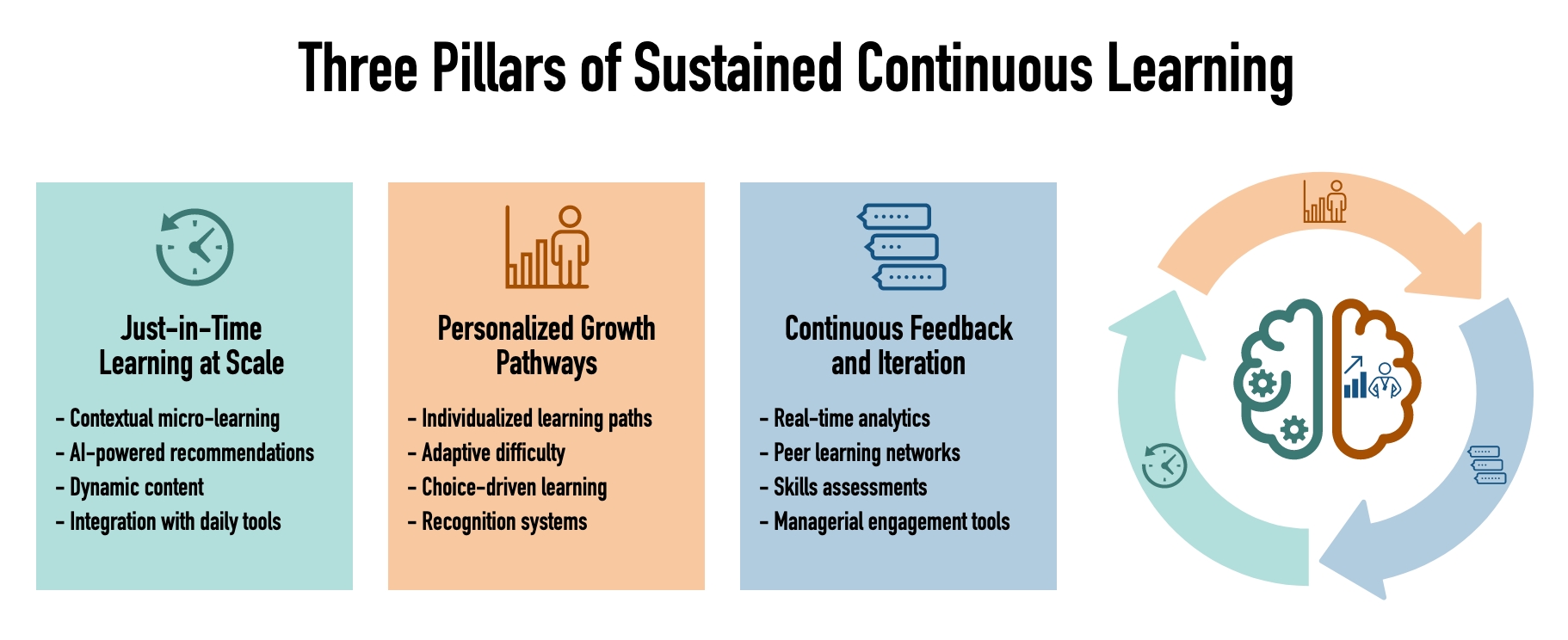
The Three Pillars of Sustained Continuous Learning
1. Just-in-Time Learning at Scale
The key to sustaining engagement is delivering learning exactly when employees need it, not weeks in advance or after they've already struggled. In 2026, successful organizations will leverage intelligent digital adoption platforms that provide:
- Contextual micro-learning modules triggered by specific user actions or workflow stages
- AI-powered recommendations that anticipate knowledge gaps before they impact performance
- Dynamic content that adapts to industry trends and technology updates automatically
- Integration with daily tools so learning happens within the natural workflow, not as a separate activity
2. Personalized Growth Pathways
One-size-fits-all training programs fail because every employee's learning journey is unique. Advanced continuous learning strategies in 2026 must offer:
- Individualized learning paths based on role evolution, career aspirations, and current skill levels
- Adaptive difficulty that adjusts based on employee proficiency and learning pace
- Choice-driven learning that allows employees to pursue interests aligned with both organizational needs and personal growth
- Recognition systems that celebrate micro-achievements and milestones, maintaining motivation over time
3. Continuous Feedback and Iteration
Sustained learning requires ongoing measurement and refinement. Organizations in 2026 need:
- Real-time analytics that identify knowledge gaps before they affect productivity
- Peer learning networks that enable knowledge sharing and collaborative problem-solving
- Regular skills assessments that help employees visualize their growth trajectory
- Managerial engagement tools that prompt leaders to discuss learning and development in everyday conversations
The Cost of Inaction
Many organizations still fail to invest adequately in structured continuous improvement programs, viewing them as "nice to have" rather than essential. This mindset carries significant consequences:
- Higher Turnover Costs: Employees, especially younger generations, prioritize learning and development opportunities. Organizations that fail to provide ongoing growth see 25-30% higher turnover rates.
- Competitive Disadvantage: Companies with weak continuous learning cultures struggle to adapt to market changes, falling behind more agile competitors.
- Lost Productivity: Without continuous skill development, employees work less efficiently, costing organizations an estimated 15-20% of potential productivity.
- Innovation Stagnation: Organizations that don't foster continuous learning fail to capitalize on employee insights and innovations that drive competitive advantage.
Practical Strategies for 2026
To address the continuous learning challenge effectively, organizations should implement these strategic approaches:
Strategy 1: Embed Learning in Workflow
Rather than pulling employees away from their work for training, integrate learning directly into their daily activities:
- Deploy digital adoption platforms that provide in-app guidance and tooltips
- Create searchable knowledge bases accessible within business applications
- Implement AI assistants that answer questions and guide users through complex processes
- Design workflows that include reflection points for learning reinforcement
Strategy 2: Gamify Continuous Development
Maintain engagement by making learning rewarding and visible:
- Introduce skill badges and certifications that employees can showcase
- Create team learning challenges that foster friendly competition
- Implement point systems that translate learning activities into tangible rewards
- Develop leaderboards that celebrate both individual achievement and collaborative learning
Strategy 3: Manager Enablement
Equip managers to champion continuous learning within their teams:
- Provide managers with dashboards showing team skill development and engagement
- Train leaders to conduct meaningful development conversations regularly
- Build learning time into team schedules and workflows explicitly
- Reward managers whose teams demonstrate consistent skill growth
Strategy 4: Technology-Enabled Personalization
Leverage advanced platforms like GRAVITY to deliver truly personalized learning experiences:
- Use analytics to identify individual learning preferences and optimal times
- Deploy adaptive content that evolves based on user progress and feedback
- Implement recommendation engines that suggest relevant learning based on role changes or project assignments
- Enable self-service learning creation so subject matter experts can contribute content easily
Strategy 5: Measure What Matters
Move beyond completion rates to measure real learning impact:
- Track skill application in real work scenarios, not just training completion
- Monitor time-to-proficiency for new features and processes
- Assess the correlation between learning engagement and performance outcomes
- Gather qualitative feedback on learning experience and perceived value

Embrace the digital adoption platform of tomorrow - GRAVITY
The Digital Adoption Updates You Can't Miss - Subscribe Now!
Join Our Monthly Author Call – Stay Ahead of the Curve with the Latest Trends!
GRAVITY: Your Partner in Continuous Growth
GRAVITY's platform is meticulously designed to meet the sophisticated onboarding challenges. We provide the tools and insights necessary to build and sustain a thriving learning culture. We empower organizations to:
- Sustain Deep Proficiency: Keep your workforce's skills razor-sharp with ongoing, contextual support that reinforces knowledge and introduces new capabilities in the flow of work.
- Adapt with Unmatched Agility: Seamlessly roll out new technologies and evolving processes with minimal disruption, ensuring your entire organization can pivot and adapt as one.
- Empower and Engage Employees: Provide the just-in-time support that not only enhances knowledge retention and reduces frustration but also signals a deep investment in employee success.
- Cultivate a True Learning Culture: Transform learning from a sporadic event into an ongoing, engaging journey that becomes a cornerstone of your company's identity.
By embracing a holistic strategy of sustained, continuous learning, you can future-proof your workforce, unlock new waves of innovation, and secure a powerful, lasting competitive advantage.
Conclusion: From Challenge to Opportunity
The continuous learning challenge of 2026 is not merely a problem to solve – it's an opportunity to reimagine how organizations develop their most valuable asset: their people. By moving beyond initial onboarding programs to embed learning into the fabric of daily work, organizations can create environments where growth is continuous; engagement remains high, and every employee has the support they need to excel.
The question for 2026 is not whether continuous learning matters—that's already established. The question is whether your organization will embrace it fully, investing in the platforms, strategies, and culture needed to make it truly effective. Those that do will lead their industries. Those that don't struggle to keep pace.
The future belongs to learning organizations. The time to build that future is now.
References & Further Reading
Academic Research & Studies
Ebbinghaus,H. (1885). Memory: AContribution to Experimental Psychology. Teachers College, Columbia University.[Classic study on knowledge decay and the forgetting curve]
Kirkpatrick,D. L., Kirkpatrick, J. D & Kayser W. (2016). Kirkpatrick'sFour Levels of Training Evaluation. ATD Press. [Framework for measuring learning effectiveness]
Deci, E. L., &Ryan, R. M. (2000). The"what" and "why" of goal pursuits: Human needs and theself-determination of behavior. [Self-determination theory applied to learning motivation]
Kolb, D.A. (2014). ExperientialLearning: Experience as the Source of Learning and Development (2nd ed.). Pearson Education.[Experiential learning cycle and adult learning principles]
Industry Reports & White Papers
Deloitte. (2024). 2024 Human Capital Trends: The Social Enterprise in a World Disrupted. Deloitte Insights. [Annual survey on workforce development andcontinuous learning trends]
LinkedInLearning. (2024). 2024 WorkplaceLearning Report: The Skills-Based Approach. LinkedIn Corporation. [Data-driven insights on modern learningpreferences and effectiveness]
McKinsey &Company. (2024). The Stateof Organizations 2024: Getting Ahead of the Curve on Change. McKinsey Global Institute. [Research onorganizational adaptation and continuous improvement]
Digital Learning & Technology
Clark, R. C., &Mayer, R. E. (2016). E-Learningand the Science of Instruction (4th ed.). Wiley. [Evidence-based principles for digital learningdesign]
Siemens,G. (2005). Connectivism:A learning theory for the digital age. International Journal of Instructional Technology and DistanceLearning, 2(1), 3-10. [Learning theory for networked, digitalenvironments]
Practical Implementation Guides
ATD (Association for TalentDevelopment). (2024). TD Handbook: The Basics of Talent Development (2nd ed.). ATD Press. [Comprehensivepractitioner guide for learning and development]

Christoph Müller
For years I used corporate Intranets in the workplace, experiencing firsthand that traditional learning formats for IT rollouts and employee onboarding do not work. I developed GRAVITY software to tackle this challenge. Employees are happier because learning is simple and effective; businesses are happier because their IT rollouts are successful and cost a lot less than before.
Latest articles
Browse all posts